

Go Back
The Real AI Advantage Isn't ChatGPT or Claude. It's Context.
Table of Content
Picture this scenario…
You're a principal at a mid-sized venture fund. You've been tracking a B2B SaaS company for six months — solid team, interesting market, but the timing never felt right. This morning you're on a call with an LP, and they casually mention that a mutual connection just joined that same startup's advisory board. You nod. You say you'll look into it. And then the call ends, and you forget. That startup raises a Series A two months later. Someone else led the round. Now here's the same scenario, but with one difference: your AI assistant actually knows your world.
It knows who your LPs are, who they're connected to, which sectors you've been tracking, and that six months ago you added that startup to your watchlist with a note that said *"revisit when advisory board strengthens."* The moment that advisor's name shows up in a LinkedIn update, it connects the dot — and surfaces it to you before your next call. That's not a chatbot writing your emails. That's collective intelligence, working while you sleep.
Everyone's Looking at the Wrong Layer
The conversation around AI in business right now is almost entirely focused on the application layer — how to use ChatGPT to draft a memo, how to automate a workflow, how to summarize a document faster. And yes, those things save time. But they're table stakes.
The firms and investors who will build a genuine edge in the next five years aren't the ones with the best prompts. They're the ones who've figured out how to feed their AI systems with the right context — the accumulated knowledge, relationships, and signals that live inside their organization.
Think about what your fund actually knows right now:
- Why you passed on a company six months ago
- Which founders in your portfolio know each other
- Which sectors your LPs are growing bullish or bearish on
- What your thesis looked like eighteen months ago vs. today
- Which co-investors you like to work with, and why
That knowledge exists. It's in your emails, your notes, your CRM, your Slack threads, your deal memos. But it's *fragmented*. It doesn't talk to itself. And when your AI assistant doesn't have access to it, you're just using a very expensive autocomplete.
Context is what transforms a language model from a generic tool into something that actually thinks *with* you.
What Becomes Possible When You Connect the Dots
Here's where it gets interesting — and where we start to see what's actually possible for investors and operators willing to invest in context infrastructure.
Signal stacking, not just signal detection. Most firms are excited about monitoring tools that track hiring spikes, web traffic surges, or social mentions. That's useful. But imagine layering those signals against your internal notes: *this founder told you last year that they'd hire a Head of Growth before their next raise*. Now a single job posting doesn't just trigger an alert — it triggers a *specific, informed action* because your system remembers what mattered to you.
Pattern recognition across your own history. Every fund has passed on companies that went on to do very well. The question isn't whether you'll miss some — you will. The question is whether you're learning from your own decision history. An AI system with access to your deal memos, your notes, and the outcomes can start to surface uncomfortable (and valuable) patterns: *"You've passed on three developer-tools companies in seed stage citing 'crowded market' — two of them raised Series B within 18 months."*
Relationship graph awareness. The warmest introductions in VC aren't the ones you ask for — they're the ones you didn't know existed. When your AI system understands your network, your portfolio founders' networks, and your LP base, it can surface a path to a founder that would have taken you three Slack messages and a weekend to discover on your own.
Portfolio intelligence, not just portfolio monitoring. When your AI knows what's happening across your entire portfolio — the challenges, the pivots, the wins — it can start connecting founders who are facing similar problems, identify emerging themes before they become obvious, and help you show up to board meetings with a point of view, not just a slide deck.
None of this requires a custom platform or a team of engineers. It starts with something much simpler: deciding that context is worth capturing.
How to Start: Three Levels of Depth
Level 1: Claude Cowork — No Technical Skills Required
If you're using Claude today, you're probably getting maybe 20% of what it's capable of. The reason isn't that Claude isn't smart — it's that it doesn't know you.
The fastest, simplest way to change this is to build a context folder: a set of plain-text Markdown files that live in a folder you connect to Claude via Cowork. No code. No APIs. Just organized information.
Here's what a useful folder looks like:
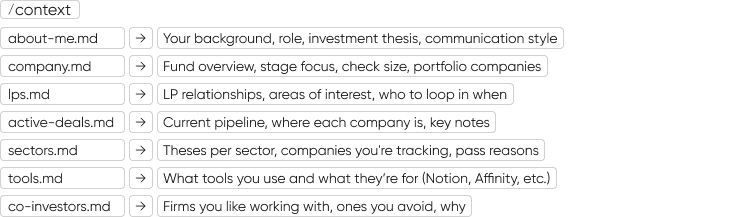
What does this unlock? Here are a few real examples:
"Based on my sector notes and the company I'm looking at today, does this fit my thesis? What questions should I be asking?"
"I just got off a call with a founder in fintech. Here are my notes. Does anything connect to companies I'm already tracking?"
"Draft a follow-up email to this founder — use my communication style and reference the specific thing we discussed about their go-to-market."
"What LP in my network would be most relevant to intro to this company, based on what I know about their interests?"
The difference between Claude with this context and Claude without it is not 10% better. It's a different tool. You've gone from a generic assistant to one that reasons inside your world.
Level 2: Claude Code — For Those Who Want More Control
If you're comfortable opening a terminal, Claude Code takes this several steps further.
Instead of just reading context files, you can build specialized agents and commands that run repeatable workflows. Think of it as moving from "a knowledgeable assistant" to "a team of specialists, each trained on exactly what they need to know."
A few examples of what this looks like in practice:
Deal Research Command — Drop a company name, get back a structured research report that pulls from your thesis, your pass history, and live data — formatted exactly the way your team reviews deals.
Weekly Signal Digest — A scheduled agent that scans your watchlist, checks for hiring changes, news mentions, and funding announcements, and surfaces only the things that matter given your current focus.
Meeting Prep Agent — Feed it a calendar event, and it returns a briefing note with everything you need: who you're meeting, what you know about them, relevant portfolio connections, and three smart questions based on your prior context.
Portfolio Pattern Report — A command that synthesizes your active portfolio notes and surfaces cross-portfolio themes, founder connections worth making, and areas where you're seeing systemic risk.
Claude Code also lets you define skills — reusable frameworks your agents follow consistently. So your deal memos always follow your preferred structure. Your founder updates always get processed the same way. Your sourcing notes accumulate in a format that becomes queryable over time.
This is where individual productivity starts becoming organizational intelligence. The frameworks you build become assets your whole team can use.
Level 3: Time to Scale — Bring Us In
At some point, you've found something that works. A workflow that's genuinely saving you time. A context structure your team has adopted. A signal-detection system that's already surfaced two good conversations.
That's when it's time to stop duct-taping it together and build it properly.
This is where we come in. Once you've validated a framework that creates real value, we help you:
- Harden the infrastructure — move from local MD files to a proper knowledge base that syncs with your CRM, Slack, email, and deal-flow tools
- Build team-level agents — so the intelligence isn't locked to one person's laptop, but available across the whole firm
- Create proprietary data moats — structured capture of your decision history, your relationship graph, and your institutional knowledge, in a form that compounds over time
- Deploy and maintain — monitoring, iteration, and ongoing development as your workflows evolve
The firms that will win the next decade of VC aren't the ones with the biggest funds or the best brand. They're the ones who figured out how to turn their accumulated knowledge into a systematic advantage — and who started building that infrastructure before it became obvious everyone needed it.
The Path Forward
The AI revolution isn't about replacing human judgment. It's about making human judgment faster, better-informed, and more connected to everything you already know.
The founders who will define the next era of venture capital aren't waiting for some perfect platform to emerge. They're starting now — with a folder of Markdown files, a clear thesis written down, and the discipline to capture what they know before it evaporates into the noise.
Context is the moat. Start building yours.